
Electrodeionization is a modern, chemical‑free way to produce high‑purity water using electricity, membranes, and ion exchange resins—making it ideal as a polishing step after reverse osmosis in industrial water treatment systems. If your facility needs consistent, ultrapure water for production, now is the right time to explore whether an electrodeionization solution from our team is the right fit for your process.
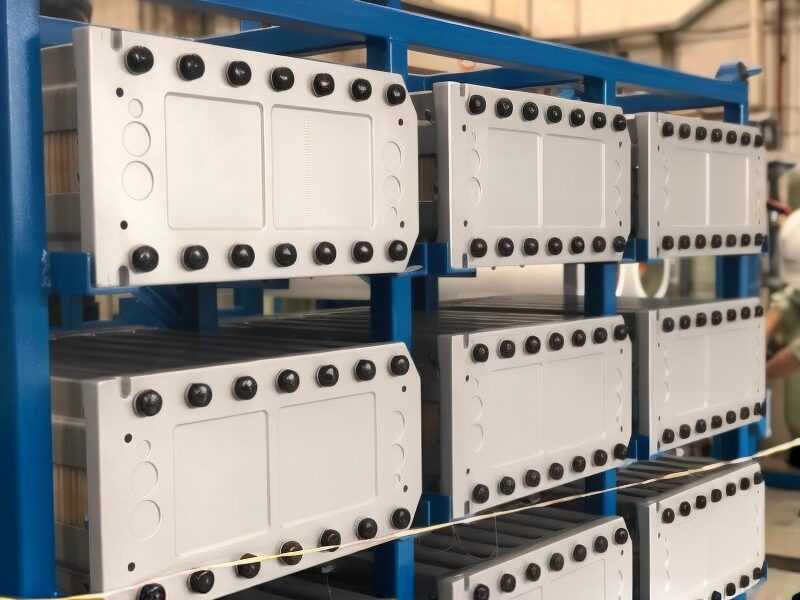
What is electrodeionization?
Electrodeionization (EDI) is a water treatment technology that removes dissolved ions (such as calcium, sodium, chloride, and silica) using direct current (DC) power, ion‑exchange membranes, and ion‑exchange resins. It is typically used after reverse osmosis (RO) as a “polishing” step to reach very low conductivity and high resistivity levels required in critical applications.
Unlike conventional mixed‑bed ion exchange, EDI operates continuously and regenerates its resins electrically, so it does not require periodic shutdowns for chemical regeneration with acids and caustics.
How electrodeionization works
An EDI module contains multiple narrow chambers packed with ion exchange resin and separated by cation and anion‑selective membranes. Pre‑treated water—usually RO permeate—flows through the dilute chambers while a DC electric field is applied across electrodes at each end of the stack.
Within the module, ions in the water are captured by the resin and then driven across the membranes toward concentrate chambers by the electric field, leaving behind deionized product water. The membranes only allow ions of the appropriate charge to pass, so cations move through cation‑selective membranes and anions through anion‑selective membranes, where they are swept away in a separate concentrate stream.
A key feature of EDI is “self‑regeneration”: at the interface of the resins and membranes, the electric field splits water into hydrogen (H⁺) and hydroxide (OH⁻) ions, which continually regenerate the resin in place. This water‑splitting reaction keeps the resin in its active form, so the system can run continuously without the logistics, hazards, and downtime associated with chemical regenerations.
Industrial uses of electrodeionization
Electrodeionization is widely used anywhere stable, ultrapure or high‑purity water is a process or product requirement. In power generation, EDI is used to produce high‑purity boiler feedwater to protect turbines and heat‑recovery systems from scale and corrosion.
Pharmaceutical and biotechnology facilities rely on EDI to produce purified water and water for injection (WFI) pretreatment, support clean‑in‑place (CIP) systems, and maintain compliance with stringent pharmacopeia and GMP guidelines. In microelectronics and semiconductor manufacturing, EDI helps deliver extremely low‑conductivity water for wafer rinsing and cleaning steps where even trace ionic contamination can impact yield.
Additional applications include food and beverage ingredient water, rinse water in precision manufacturing, and any industrial process where consistent, low‑conductivity water improves product quality or equipment reliability. In many of these systems, EDI has replaced or reduced the use of chemically regenerated mixed‑bed ion exchange as a final polishing step after RO.
Typical EDI process train
A common high‑purity system design positions EDI downstream of multiple pretreatment steps. A simplified process might look like this: media filtration and softening (if needed), followed by cartridge filtration, reverse osmosis, and then EDI for final polishing to ultrapure levels.
EDI is sensitive to certain foulants, so upstream treatment is tailored to control hardness, organics, particulates, and carbon dioxide to protect the EDI modules and maintain performance. With the right pretreatment and monitoring, EDI systems can deliver stable water quality with minimal operator intervention over long operating periods.
Advantages of electrodeionization
Electrodeionization offers a combination of water quality, safety, and lifecycle benefits that make it attractive for many industrial users. Because the resin regenerates electrically, EDI eliminates on‑site storage and handling of bulk acid and caustic for regeneration, which improves plant safety and reduces chemical footprint.
EDI modules can produce very high‑purity water—resistivity up to around 18 MΩ‑cm—with excellent removal of ions and silica when properly designed and operated. The process is continuous, so there is no need to take units offline for regeneration, which supports consistent production and simplifies automation.
From an environmental standpoint, EDI is often considered more sustainable than traditional ion exchange because it uses electricity instead of large volumes of regenerant chemicals and rinse water. Specific energy consumption is typically modest, often on the order of 0.1–0.2 kWh per cubic meter of product water, depending on system design and feedwater quality.
Considerations and when EDI is a good fit
While EDI is powerful, it is not a stand‑alone treatment for all contaminants; it primarily removes ionized species and does not directly address particles, most organics, microorganisms, or dissolved gases, so these must be controlled with complementary technologies. Successful EDI design requires careful attention to feedwater quality, including hardness, silica, CO₂, and oxidants, as well as appropriate pretreatment and system controls.
For facilities with continuous or high‑volume demand for high‑purity water, the reduced chemical handling, continuous operation, and stable product quality often make EDI a compelling alternative to mixed‑bed ion exchange. In many retrofit projects, EDI is integrated into existing RO systems to improve water quality, lower operating risk, and support corporate sustainability goals.
If your plant is planning an expansion, modernizing an aging deionization system, or working to reduce chemical usage, an engineered electrodeionization solution may deliver both operational and environmental benefits over the long term. Our team can evaluate your current water treatment train, model expected EDI performance, and design a system tailored to your quality, capacity, and compliance requirements.
Ready to explore electrodeionization for your facility?
Electrodeionization brings together ion exchange and membrane technology to deliver continuous, chemical‑free, high‑purity water for demanding industrial applications. If you are considering upgrades to your high‑purity water system, contact us today to discuss how an electrodeionization solution could improve reliability, quality, and safety in your operation.